IFRS 9-ECL
Expected Credit Loss Engine
End-to-end platform for portfolio assessment, model development, ECL calculation, and regulatory reporting — fully compliant with IFRS 9, Basel III, and local central bank requirements.
Stage Assessments
Calculation Methods
Model Studio Tabs
Report Templates
Calculate. Govern. Report — ECL with confidence.
The IFRS 9-ECL Platform
All modules working in concert — an animated tour of your unified platform
Individual Assessment
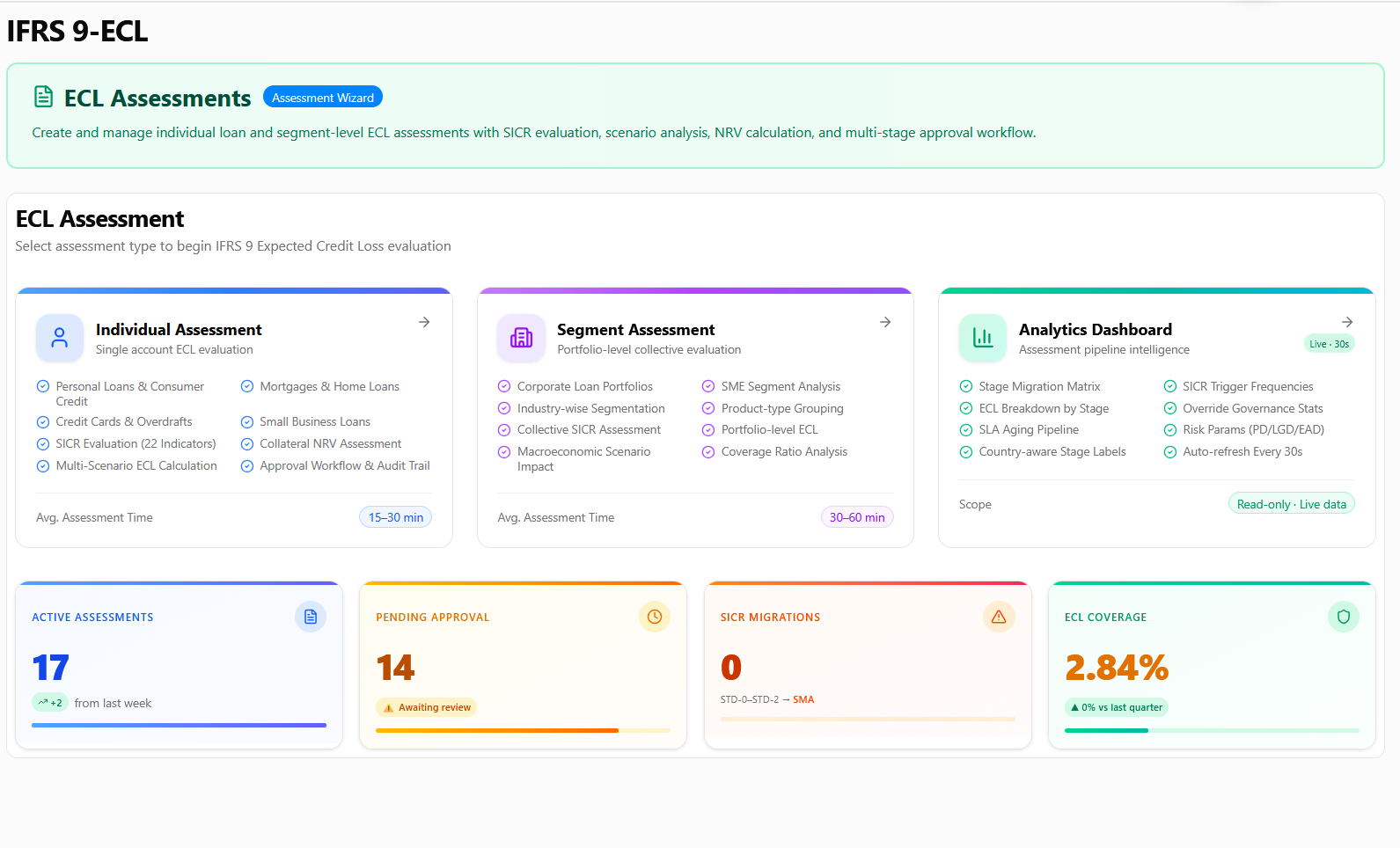
End-to-End in Five Modes
The platform operates across five integrated modes — from data intake through regulatory filing — each serving different user groups and use cases.
Portfolio Assessment
Guided 7-step wizard transforms CBS data into auditable risk parameters with SICR evaluation, DPD analysis, scenario modeling, and ML-driven recommendations.
Model Studio
Unified workspace for PD, LGD, EAD, SICR, Macro, Collateral, and CCF configuration — with version control, 4-eye approval, and full audit trail.
ECL Calculation
Four calculation methods (Standard, Simplified, Monte Carlo, Advanced) with scenario weighting, discount factors, and batch processing for 100K+ exposures.
ECL Analytics
Real-time dashboards with stage migration analysis, sensitivity analysis, backtesting, cashflow timelines, and run comparison for board-level reporting.
Analytics & Audit Trails
Immutable audit trail with cryptographic chaining, 9-dimension ML recommendations engine, regulatory compliance mapping, and complete chain-of-custody logging.
Portfolio Assessment
Guided 7-step wizard transforming raw CBS data into auditable risk parameters — from portfolio selection through ML-driven recommendations.
Portfolio Selection
Auto-populated loan data from Core Banking System — zero manual entry.
SICR Evaluation
Quantitative, qualitative, and jurisdiction indicators determine Significant Increase in Credit Risk.
Delay Analysis
Country-specific DPD thresholds aligned to IFRS 9 and local regulatory requirements.
Scenario Analysis
Multi-scenario probability-weighted ECL with World Bank, IMF, and central bank data.
NRV Collateral Assessment
Methodical collateral discount cascade producing defensible Net Realizable Value.
Regulatory Reports
Auto-generated CL-1 through CL-5 regulatory forms with EDW upload and 50+ templates.
Analytics & Audit Trails
Immutable audit trail, ML recommendations engine, and comprehensive ECL analytics.
Model Studio
Unified configuration workspace — develop, calibrate, and govern all risk parameters with 4-eye approval and version control.
PD Configuration
15 Model Methodologies
15 methodologies for estimating Probability of Default across rating grades and segments
- TTC vs PIT calibration methods
- 22-grade rating scale (S&P/Moody's/Fitch aligned)
- Term structure: constant hazard, Kaplan-Meier, Markov chain
Configuration Preview
+ 7 more methodologies
ECL Calculation Engine
Four calculation methodologies — from deterministic to stochastic — choose the right approach per portfolio segment and regulatory requirement.
Stage Distribution
Stage 1
65%
Stage 2
25%
Stage 3
10%
ECL Trend (6 Months)
Scenario Analysis
Probability-weighted ECL under IFRS 9 §5.5.17 with real-time macroeconomic data from World Bank, IMF, and central banks.
Live macroeconomic data streams from World Bank, IMF & central banks
Baseline
50% weightMost likely economic trajectory based on current forecasts
GDP
3.5%
Unemployment
5.2%
Interest
6.5%
Optimistic
25% weightFavorable conditions with accelerated growth
GDP
5.0%
Unemployment
3.8%
Interest
5.0%
Pessimistic
25% weightAdverse scenario with recessionary stress
GDP
1.2%
Unemployment
7.5%
Interest
8.5%
Global Data Integration
GRC Sphere integrates real-time macroeconomic data from World Bank, International Monetary Fund (IMF), and central bank statistical databases. GDP growth, unemployment rates, inflation trajectories, property price indices, and interest rate forecasts are automatically populated — ensuring forward-looking ECL assessments reflect the most current global and domestic economic outlook.
Regulatory Reports
Comprehensive regulatory reporting with auto-generated CL forms, EDW upload, CIB reporting, and 50+ pre-built templates.
Reporting Templates
CL Form Automation
CL-1 through CL-5 generated in seconds from CBS data.
EDW Upload
Batch management, validation, multi-channel delivery (FTP/SFTP), and submission history.
50+ Report Templates
Bangladesh Bank templates for capital adequacy, liquidity, large exposure, and migration.
Regulatory Frameworks
Built-in alignment with global accounting and regulatory standards
Expected credit loss accounting standard
International regulatory capital framework
Current expected credit loss methodology
Insurance contracts accounting standard
Jurisdiction-specific accounting principles
Central bank credit risk guidelines
Plus IAS 1, IAS 39, and additional local regulatory reporting frameworks
Industries We Serve
Tailored IFRS 9-ECL solutions for financial institutions, lenders, and regulated entities across diverse sectors.
Banking
IFRS 9 for Banking Portfolios
Banks must calculate expected credit losses across diverse loan portfolios under IFRS 9. IFRS 9-ECL provides ML-powered ECL modeling, multi-scenario SICR evaluation, stage classification, and 50+ regulatory report templates — supporting standard, simplified, Monte Carlo, and multi-period calculation methodologies.
Fintech
ECL for Digital Lending
Digital lenders need robust credit loss calculation for regulatory compliance and investor reporting. IFRS 9-ECL delivers automated ECL calculations, portfolio assessment workflows, and scenario analysis — helping fintech lenders meet IFRS 9 requirements with scalable credit risk infrastructure.
Insurance
IFRS 9 for Insurance Investments
Insurance companies with credit exposures must calculate expected credit losses on bonds and other debt instruments. IFRS 9-ECL provides dedicated ECL modeling for insurance portfolios, supporting the unique credit risk profiles and regulatory requirements of the insurance sector.
Capital Markets
IFRS 9 for Investment Portfolios
Capital markets firms managing credit-sensitive instruments require precise ECL calculations. IFRS 9-ECL delivers sophisticated credit loss modeling, Monte Carlo simulation, and multi-scenario analysis for trading books, bond portfolios, and structured credit products.
Portfolio-to-Audit workflow
Standard / Simplified / MC / Advanced
CL-1 to CL-5 • EDW ready
Global portfolio coverage
Why IFRS 9-ECL?
The platform that transforms ECL compliance from spreadsheet burden into automated precision
Automated ECL
PD × LGD × EAD with stage allocation, scenario weighting, and discount factor application.
Stage Migration
Real-time monitoring with SICR triggers, cure tracking, and multi-level approval workflows.
Model Studio
Full lifecycle management with calibration, backtesting, version control, and validation.
Scenario Engine
Probability-weighted ECL with live World Bank/IMF macro-economic data integration.
Dual Alignment
Simultaneous compliance with IFRS 9 international and local central bank requirements.
Audit Ready
Immutable audit trail, disclosure templates, and submission-ready regulatory reports.
Frequently Asked Questions
Everything you need to know about IFRS 9-ECL
ECL With Confidence
See IFRS 9-ECL in action. Schedule a demo and discover how to automate expected credit loss with precision and governance.